Refresh your skills
Keep your skills sharp and your certification current with our Wilderness First Responder Recertification (WFR-R) course, offered in partnership with SOLO Wilderness Medicine. This 2 day course is designed for WFR-certified individuals who need to refresh and update their wilderness medicine knowledge. Through hands-on practice and scenario-based learning, you’ll review essential skills, learn the latest protocols, and ensure you’re prepared to handle medical emergencies in remote environments. Stay ready for the wilderness by renewing your WFR certification!
Recommended For: Students whose current WFR Certification is due to expire.
Prerequisites: Previous WFR Certification
Tuition
$280 tuition fee
Course Length
16+ hours
Certificate
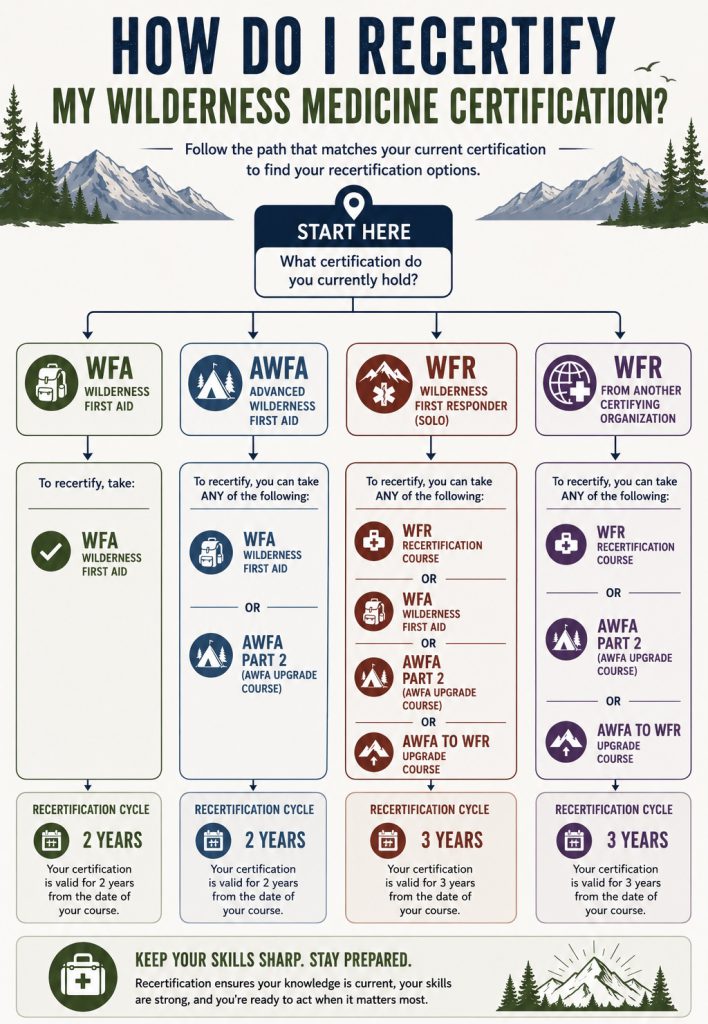
WFR certificate valid for 3 years

Other ways to recertify with a current SOLO WFR
- Wilderness First Aid
- Bridge Courses
- 2 day WFA to AWFA bridge course
- 4 day AWFA to WFR bridge course
At the conclusion of these courses, you will take the WFR Recertification exam and you will have to complete the application process on the SOLO website before receiving you new WFR certification. There is a $15 recertification fee. You must get 70% or higher on the exam. You can find the link to the application process here.
Other ways to recertify with a different organization WFR
- Bridge Courses
- 2 day WFA to AWFA bridge course
- 4 day AWFA to WFR bridge course
At the conclusion of these courses, you will take the WFR Recertification exam and you will have to complete the application process on the SOLO website before receiving you new WFR certification. There is a $15 recertification fee. You must get 70% or higher on the exam. You can find the link to the application process here.
WFR-R Course Details
SOLO courses are highly interactive and focus on hands-on learning, with numerous outdoor scenarios and skills labs. This allows participants to practice and refine their skills in real-life conditions. Please be prepared to spend time outside, regardless of weather conditions—rain, snow, or shine.
Class typically begins at 8:00am and end by 6pm, with breaks for meals. The course includes a mix of hands-on activities and classroom-based learning, with both indoor and outdoor scenarios, so dressing appropriately for the weather is essential.
Must pass final written exam and show skills competency to receive new WFR certification.
Lodging: We have an onsite lodging option
Ready to Enroll for WFR-R?
Select a date to sign-up and pay your tuition. If you are a Kalamazoo College student, Staff/Faculty, or Alumni, check out your discount code here.
Course Information and Preparation
Course Outcomes
Refresh and update essential wilderness medicine skills, ensuring you remain proficient in assessing and treating injuries and medical emergencies in remote areas.
Learn the latest protocols and best practices, incorporating the most up-to-date techniques in wilderness medicine.
Reinforce hands-on emergency care through scenario-based practice, improving confidence in real-world situations.
Preparing for your Course
To help set yourself up for success, we strongly encourage all participants to spend time reviewing key wilderness medicine topics before the course begins.
Coming prepared and confident with your foundational skills will allow you to get the most out of the course, fully participate in scenarios, and focus on advancing your wilderness medicine training.
Below you will find recommended review videos, study materials, and an online quiz to help refresh your knowledge and identify areas where you may want additional practice.
Videos to review:
- Patient Assessment System (PAS) review
- Focused Spine Assessment (FSA) review
- Splinting Videos (feel free to check out their other splinting videos)
You can use the provided WFR Practice Quiz (linked below) to review and help prepare for the course. This is an excellent resource for refreshing key WFR concepts. There are over 300 questions on this quiz so do not feel obligated to do all of them. This is just a resource for you to see what you know and what you want a refresher on.
Supplies List
You should plan to have clothing that will be appropriate to the season for where and when you will be taking the class. Weather permitting, we will be spending a significant portion of the class time outside. The following list is to supplement the clothing you will be wearing. You are free to supplement it with anything else you would normally carry. You will be using your equipment to provide care, build splints, and to keep yourself and OTHERS warm. If you have questions regarding the usual weather where your course will be held, please contact the sponsor.
We will be providing some clothing for splinting materials, sleeping pads, and training med kits.
Please note, we use moulage throughout the training that can stain some clothing, therefore, you may want to bring older or darker clothing to wear for scenarios.
Required Items
The following items should be packed for each class:
- Backpack to put everything in
- Extra clothing (for layering and to use in splints)
- Items that you would normally take on a day hike or overnight hike
- Raingear tops and Bottoms
- 2 Warm Hats (synthetic* or wool)
- 1 Pair Warm Gloves or Mittens (synthetic* or wool)
- 2 Pair Warm socks (synthetic* or wool) or wool)
- Warm Top and Bottom Layer (synthetic* or wool)
- 2 Pair Warm socks (synthetic* or wool)
- 2 Water Bottles (1 liter/quart or larger)
- Hiking boots or Sturdy Hiking Shoes (no Five Fingers shoes please)
- Notebook with Pen/Pencil
- Watch with Second Hand (or digital with seconds)
Helpful Things to Bring
- Headlamp or Flashlight (don’t forget extra batteries and bulbs)
- Pocket Knife
- Insect Repellent (in season)
- Sunglasses and Sunscreen
- 40 feet Small Diameter Cord (parachute cord is fine)
- Sleeping Pad (Ensolite, Thermarest, Ridgerest, etc.)
- 10’ X 10’ 4-6 mil Plastic Tarp (for shelter building)
- Bandanas/Cravats of any kind
*Polyester or Polypropylene (Capilenetm, Bergelenetm, Dri-Climetm, etc.) We do not recommend cotton which loses its ability to hold heat if wet.
What to Expect After Enrollment
After enrolling in an Outdoor Leadership Training Center course and paying the tuition, you can expect a e-receipt to be sent to you immediately.
All courses will be held on Kalamazoo College’s campus. You will receive an email closer to the course date with details such as your class’s location, parking, etc.